
"Ptydepe" or the dangers of connecting language and power
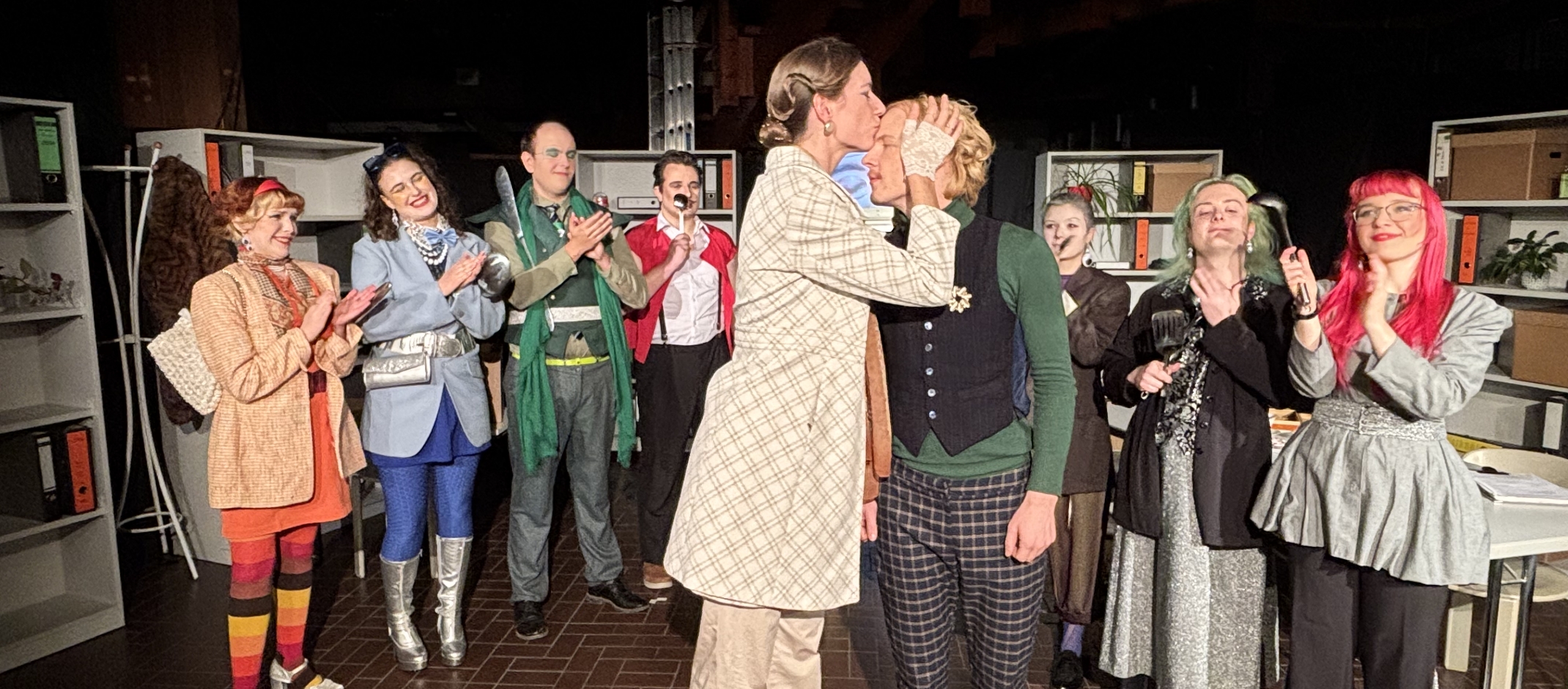
Imagine showing up to work one morning only to be met with a message in a foreign language you do not understand and that has just been made the official language. Worse yet, everyone else has already learned the new language. This is what happens to Josefine Groß, director of an unnamed office and a confident woman in a position of power, authority and privilege. Her secretary states that the memo she has received in the new official language Ptydepe is important, but he is not permitted to translate it. This is how Václav Havel's absurdist play "The memorandum" kicks off. The piece was directed by Cecilia Amann and performed by the University of Konstanz theatre on campus from 18 to 23 November 2025.
At first, Groß – played brilliantly by Marie Puschmann – laughs things off, but then becomes increasingly desperate as she tries to decipher the memo, and stumbles upon a Ptydepe language course. The scene is very creatively visualized as an online course with participants appearing as on-screen videos (video director: Kaja Brenner). The course is led by an out-of-touch Ptydepe expert (Niko Hönig), who teaches that the language is a precise language, based on scientific criteria, that finally does away with the ambiguity of natural languages. The longest word in the language, used for an imaginary animal, has more than 300 letters, and it is impossible to ever truly learn the language – a jab at the academic community.
The translation office also cannot provide any help, because to get a translation, additional conditions have to be met that all depend on each other and thus cannot be resolved.
© Claudia Marion Voigtmann
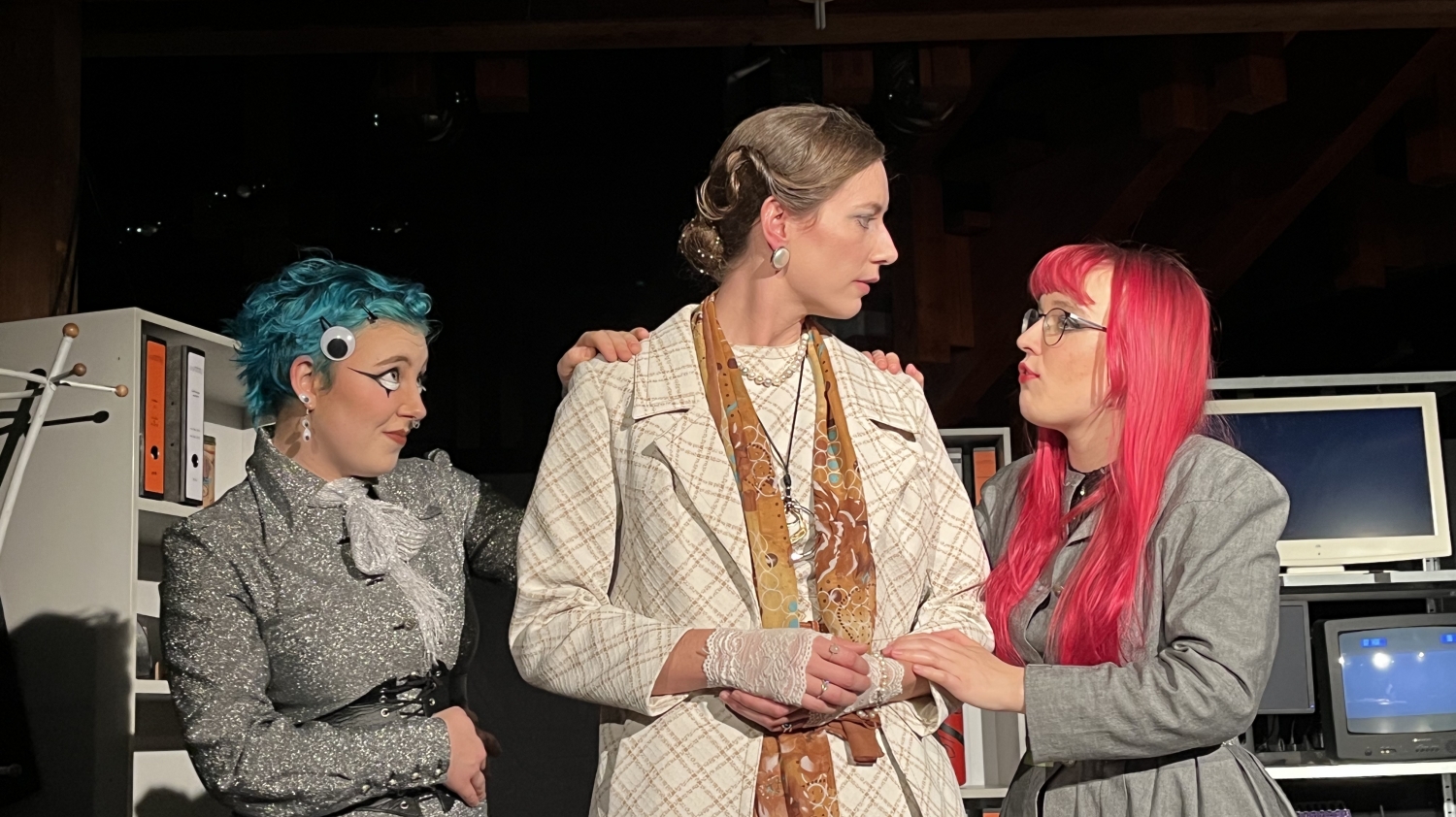
Yet who is behind the memo? What are their true motives for sending it? Vice director Balas (played outstandingly by Annika Siewert as the sophisticated antagonist) soon reveals that she not only gave the order to introduce Ptydepe as the official language but, because of an intrigue, can force director Groß to bow to the will of the masses. As Groß quits and gives Balas her position, her subordinates show their true natures – some are schemers, others opportunists and still others are simply too slow to take any action at all. In a very pointed and skillful way, the young actors of the university theatre expose the weaknesses of their characters in a microcosm that is representative of a social community under a state apparatus.
The turning point comes when the young secretary Marvin (Jakob Sanowski) is the only person to act autonomously and translates the memo despite not being permitted to do so. In fact, the memo lauds Groß for taking a stance against introducing constructed languages such as Ptydepe. At this moment, director Balas realizes how fleeting and shaky positions of power can be, and as she is asked to vacate her position, she readily hands it back to Groß. The status quo from the beginning is restored, and the characters flounce off the stage in their imaginative costumes to enjoy the high point of a day in the office: lunchtime.
So all's well that ends well? Only at first glance: The director abandons Marvin, the virtuous character, when the crowd turns against him. In doing so, she loses her own integrity as well as the humanity that she had continued to invoke throughout the piece.
"The memorandum is clearly a clever and dark analysis of what Havel saw as the conditio humana. It analyzes the unconditional, unlimited pursuit of power on the part of some, and the often voluntary subordination of others – who keep silent, look the other way and try not to stick out."
Miriam Finkelstein, a professor of Slavic literature and general literary studies at the University of Konstanz who had suggested the piece.
Along with Bernhard Brehmer, a professor of Slavic linguistics, Finkelstein currently teaches a seminar on the topic of constructed languages in and from Eastern Europe.
After Ptydepe was rejected as an official language, absurdly enough, the on-stage discussion turns again to the next synthetic language, and the cycle begins anew. In this way, the play portrays the interplay between language and power, how language and power are linked and how those in power employ a certain type of language.


 All against one - Groß (Marie Puschmann) confronted by the head of the translation centre (Kaja Brenner), Harald (Jakub Kaminski), Kubsch (Lara Reichel) and Balas (Annika Siewert) (from left)
 In the Ptydepe seminar
 A hint of romance: Groß (Marie Puschmann) and Marvin (Jakob Sanowski)
 In the director’s chair: Kubsch (Lara Reichel) and Balas (Annika Siewert) (from left)
Under the guidance of university theatre director Cecilia Amann, the troupe of actors treats its viewers to an entertaining and thought-provoking performance. The students captivate their audience and invite them into the story, to laugh along as well as think about what they have seen. Herself an experienced actor and director, Cecilia Amann emphasizes:

"Our rehearsals and the ensuing performances are a joint production. The students not only had roles to play, but each of them also took on additional responsibilities – and theatre productions have so many of them: from directing the videos, to editing the film, designing the posters and running the technical equipment. The fact that everyone pitches in makes the performances so unique and working in the university theatre such an enriching experience for all of us."
Cecilia Amann, university theatre director
Title image: Cecilia Amann. Copyright: Ilka Richter